Copyright 2010 Ben S. Pollock
CEDAR FALLS, Iowa — The appearances in Iowa of the exiled spiritual and political leader of China-controlled Tibet, the 14th Dalai Lama, had a successive feel: first a closed reception for a few dozen donors on Monday, May 17, a panel discussion the next morning, then finally a solo turn that afternoon. One wanted His Holiness to hit it out of the park, but knew he’d likely further develop thoughts he’d begun earlier, yet the overall memory is one of satisfaction. Any disappointment would disappear as days melded and faded, much like a bright mandala brushed into a heap of now pastel sand.
This wasn’t summer camp, a spiritual retreat or a rock festival despite similarities. The man in the burgundy and goldenrod robes simply agreed to a couple of speeches in a state he’d not visited before. [Aspects previously covered in Lama-palooza I and Lama-palooza II.]
The title of the Dalai Lama’s keynote address,”The Power of Education,” indicated more a starting point for broad considerations rather than a subject, and indeed was the practiced ramble of an extraordinary mind.
First, before the 2 p.m. start, the University of Northern Iowa Wind Symphony played. As a recorder and low brass player, I’m a sucker for bands, and the group had it a little rough. The spring semester was over by a week or so yet they hung around for this. They were playing before an audience of 5,000 in the basketball arena (the lofty acoustics of such are frustrating, too) settled noisily into the bleachers.
The UNI president, Benjamin J. Allen, opened. He presented His Holiness an honorary doctorate. The academic collar-shawl kept slipping off the Venerable’s shoulders.
Next, the band, accompanied by several choruses, including a children’s chorale, performed Joy, composed for the visit by UNI music professor Jonathan Schwabe, a setting of a Buddhist verse. It’s sung in English, and the translation also was in the program. It advises joy, peace, health, trust. It’s a handsome piece performed with quiet passion. Hearing Joy again would be a pleasure; maybe a podcast was made. Schwabe presented the Dalai Lama with the handwritten original score; in return he received a khata white silk scarf and a blessing.
Leaving the arena later, MB and I found ourselves walking near a French horn player so I asked him about it. Schwabe sat in on some but not all rehearsals, never conducting, he said, leaving that to the director, professor Ronald Johnson. Schwabe made no changes in rehearsals that required rescoring, just requested some tempo or volume adjustments. The young man said the group was excited to be a part of something so important for UNI.
From the keynote, I offer squibs, as best as I could hear. To preserve the personal impact, I’m yet now reading the news or reviewing recordings. Recommended are videos posted on the website of the Waterloo-Cedar Falls Courier. The Dalai Lama’s language mastery is superb, but the Tibetan accent is tricky, delivered in a low monotone, despite the famously frequent laughter. The Dalai Lama’s English is clear but halting. Subjects sometimes are glossed over, verbs parts skipped.
“I am rather lazy.”
A jokey line the Dalai Lama said from time to time was a preface to a developed argument that belied it. In Denver in 2006, he prefaced comparable paragraphs with, “I am just a monk.”
“I am one of 6 billion human beings. Each deserves happiness.”
The main core of life stems from the fact that what we want, mother provides. It’s biological. Thus, “those children who get maximum affection and are taught compassion will grow and have happy lives.” Not all do.
Harmony comes from the basis of mutual respect.
Reciprocity and appreciation. “Humans have this ability, mosquitoes not so much. A mosquito bites, sucks your blood and leaves without even a look back” (laughs).
Recalls meeting Thomas Merton, the late Catholic monk. He was a compassionate Christian, as was Mother Theresa. The Dalai Lama says they were the first model Christians — by his lights — that he had met.
Knowledge is precious. There are two kinds, head and heart. “Most education goes to teach cunning — how to better exploit others.” Thus education alone can’t give happiness to the self or to the community. “This sort of education can lead to anger, hatred, jealousy.” (This from a man who reveres science.) As in the morning, he admires the freedom of religion mandate in the Indian Constitution.
“Trust is the basis of friendship.” “These days, follow the gun, follow the money — they’re common and based on fear — and these destroy trust, destroy friendship.”
Inner beauty as opposed to inner ugliness. Love — meaning romantic love — without mutual respect — cannot lead to deep and lasting friendship.
“This century should be a century of peace, a century of dialogue.”
“The world needs both external disarmament and internal disarmament. What President Obama and the Russian president are doing with reducing nuclear arms, that’s external disarmament, very good, very important. But we need to address internal disarmament” — to make the external stick. “For internal disarmament, you confront the problem then apply compassion.”
“You young people, this century is up to you.”
“The disputes are not just nation to nation but continent to continent. You must consider the entire world. It comes to: I need you, America needs Asia, Arabs need America. And so on.”
“I don’t admire American nuclear [weapons] power, but I do admire American principles: Liberty, democracy, equality, and also its creativity. Also freedom of speech and freedom of press. These are gifts to the world.”
He ends speeches abruptly: “Thank you. That’s all.”
But President Allen stands, he was sitting on the couch next to the Dala Lama. His Holiness during his speech often looked directly at Allen, touching his knee or shoulder. Allen has screened questions ready.
Allen: How should young people stay motivated for education?
The Dalai Lama recalls his own upbringing, Tibetan education being “very systematic.” He and his brother were tutored. But how to motivate a little boy who has been told he’s the reincarnated leader of a people? He was normal — “lazy” — and until age 13 or 14, indifferent to schooling. The tutor showed the children two whips that would, if needed, be used to keep them focused. His was yellow, signifying holiness and royalty.
“Holy whip makes holy pain!”
He got his laugh and said motivation even for good things can be from fear, and until 14 or 15 it was, then “I got interested in the knowledge.” From then on, he has been self-motivated. He doesn’t really answer the question about motivating regular children.
Allen: Are at their base all religions the same?
No, the Dalai Lama says. Even within Tibetan Buddhism there are lots of divisions. Religions are alike at their highest levels, in compassion and forgiveness. At their basic levels, even Buddhism has contradictions.
“But Buddha not confused. … Buddha wanted to create confusion in his students,” because it deepened their wisdom, knowledge, understanding of the world.
That is what I heard, but My Beloved says I missed a clarification he then made. I’m sticking to my notes, they make Talmudic sense.
“Some religions emphasize philosophy, some emphasize the creator. All have the same purpose, to build these human qualities. [But after that the mutualities splinter.] The differences are real, and deserve respect.”
• • •
This Iowa trip leaves me humbled, inspired and angry.
The Dalai Lama seems to be the one political or religious world leader to encourage compassion as a first principle, and with no limits.
I’m not Buddhist but a student of world religions, since childhood. The major religions all express evil qualities, including my own. For a century this is partly the fault of the mass media, where I make a living. The media — news and comment, academic and popular, cultural and mainstream — veer toward extremes. No matter what audience we’re a member of, our attention is drawn to the edges, strong statements, vivid images.
We tell the broadcast media what we want to see. Ratings propel the pseudo-historian not a fact-based analyst (how can Nazism as well-recorded as it was be so blithely referenced?). The Christian televangelist gets the sound bites for intolerance, not local pastors who counsel everyday heartbreak. Two Catholic popes have had to clean up decades of child abuse and cover-ups, while TV skips Anglican and Christian Orthodox leaders who generally emphasize the compassion of Jesus over the heaven of Christ. Arab extremists post video threats to websites, and we’re never shown Muslim benevolence. How do nationalist Jews get camera time over progressive rabbis who act from an interfaith and interethnic tradition of social justice?
The first role of a major religion should be to teach followers kindness among themselves and with other peoples. Revelation and assurance of an after-life, if they don’t promote compassion, should be secondary. What good are they, otherwise?
The Dalai Lama is an inclusive extremist. He gets the cameras and ink for wearing a robe outside the home, for scruffy brown shoes and some kind of purse because the garment apparently has no pockets. He’s the only global headliner who does not resort to exclusiveness, bile or fact twisting.
What’s his attraction, what made the long drive worthwhile? The Dalai Lama and other Tibetan clerics, the precepts of other branches of Buddhism, like Zen, as I understand them, are simple not simplistic.
Simple not simplistic works. Judaism, Christianity and Islam could go there, monotheism leads smoothly to compassion but for centuries of tribal politicization. And recent decades seem to have accelerated fear, the presumption of violence, in the West. (Thailand now is showing Eastern religions are not immune.)
• • •
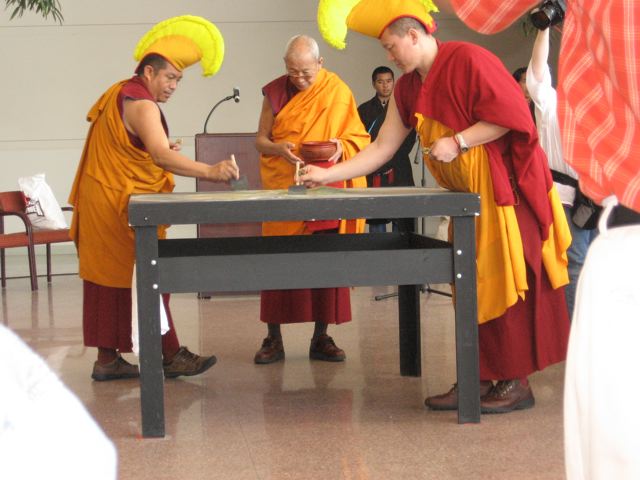
The next morning, Wednesday, May 19, UNI visiting scholar Geshe Thupten Dorjee, a University of Arkansas instructor, and two monks from Minneapolis ritually destroyed the days’ old mandala, a tabletop maze full of symbols constructed of colored sand. Literally sweeping it up once completed demonstrates the Buddhist principle of impermanance. There’s a special brass tool, a funnel of sorts, to place sand grain by grain in the ancient patterns. At the end, though, the men used common foam paintbrushes to pile the sand. Some went into tiny bags as souvenirs for we witnesses. The rest was carried to a flowing stream, and poured in.
• • •
The Dalai Lama went on to New York. The Times published a column he wrote.
Next spring, Lord willing, His Holiness will travel to Fayetteville, for at least one address at UA’s Bud Walton Arena. Chancellor G. David Gearhart will be up front of course. Iowa’s governor wasn’t here, but I can see Mike Beebe on the dais. It takes little to imagine Bill Clinton showing up as well.
I’m a third-generation Arkansawyer and UA grad (M.A. ’03), but I cringe at how some crewcut goober may hand the Tibetan leader a Razorback Hog Hat as a coach leads the fascist-arm-waving Hog Call. Please, God, help state leaders maintain dignity.
Amen and tashi delek (Tibetan salutation for “good luck”).

2 replies on “Lama-palooza III: Simple Not Simplistic”
[…] in Lama-palooza III, while Lama-palooza I serves as an intro. This was written by Ben. Posted on Thursday, May 27, […]
[…] overall visit embedded something vital. This Brick, Lama-palooza I, along with Lama-palooza II and Lama-palooza III, will consider this roundabout couple of days only as straightforwardly as needed. [The running […]