PHILADELPHIA — While columnist conferees last Friday toured both the Liberty Bell and Independence Hall, I had a 40-year closure issue with Benjamin Franklin so My Beloved and I skipped the latter.
When I was age 10 3/4, late summer 1968, Dad had business in Camden, N.J. Time for a road trip! From Fort Smith, we first drove my sister to the University of Tennessee at Knoxville, where she would have been starting her sophomore or junior year. The eastbound destination, for Mom and me, wasn’t Jersey but Philadelphia (we then drove to New Orleans for business then back to Arkansas).
The Pennsylvania stop turned into an oft-told family story: We saw the main historical sites in an afternoon, ending at Christ Church Burial Ground. We reflected on the grave-and-a-half-wide flat stone covering the remains of Franklin and his wife, Deborah. Being such an old churchyard we explored it, seeing resting places of other signers of the Declaration of Independence. It was dusk and soon time for dinner. But the gate was locked. Whoever closed the cemetery for the night didn’t see we still were there. We shouted to passers-by. The caretaker was just down the street, fortunately, and he returned to let us out.
Having not been back to Philly since, I had to see the grave again. Coincidentally, it was closing time again — who ever heard of shutting down a tourist site at 4 p.m. in the middle of visitors’ season? The two young bucks at the gate let us in for five minutes, until 4:15, just to see Franklin’s grave, for half price, a dollar apiece.
Lingering at the site were a man and his two young daughters. As we approached the girls were jumping on the flat stone, about 8 inches off the ground, and the dad was doing nothing. Sacrilege! To make it worse, we realized he was pitching pennies on this hallowed spot.
“Finally, got a ‘heads.’ Let’s go, kids,” he said.
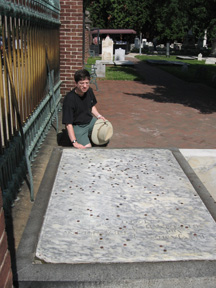 We took their place and saw dozens of coins on the marker, mostly but not all pennies. Jews put a pebble on a grave as a mark of respect, but this was not that. This seemed to be defacement, because Franklin said, “A penny saved is a penny earned,” and here pennies were being the opposite of being saved.
Ever the journalist, I asked one of the moneychangers at the religious property’s gate. He said it was a tradition. How long? “As long as I can remember,” the obviously native Philadelphian said, and the other guy nodded assent. Why? “You try to get heads.” Why? “Heads is good luck.”
Luck is not a concept associated with Franklin the pragmatist, but the tradition began long after he could have coined an aphorism to condemn it. The tradition had to have begun in recent decades, unless that old caretaker with cataracts and few teeth had removed the pennies for the day, before the Pollock family arrived in 1968.
Got to accept these things, I suppose. Research confirmed the coin-to-fountain adaptation. Stu Bykofsky, in the seminal Stu Bykofsky’s Little Black Book: A Gentleman’s Guide to Philadelphia (1995, Black Tooth Press), writes, “It’s tradition to toss pennies (for A Penny Saved Is A Penny Earned) on the engraved stone that covers his grave” (pg. 91).
If Byko writes it, it’s so. -30-
